The Factory Was the Real Invention
The factory, not the machine, was the real invention. The final post in the series: how the organisation decides what AI productivity is worth, and who it is for.
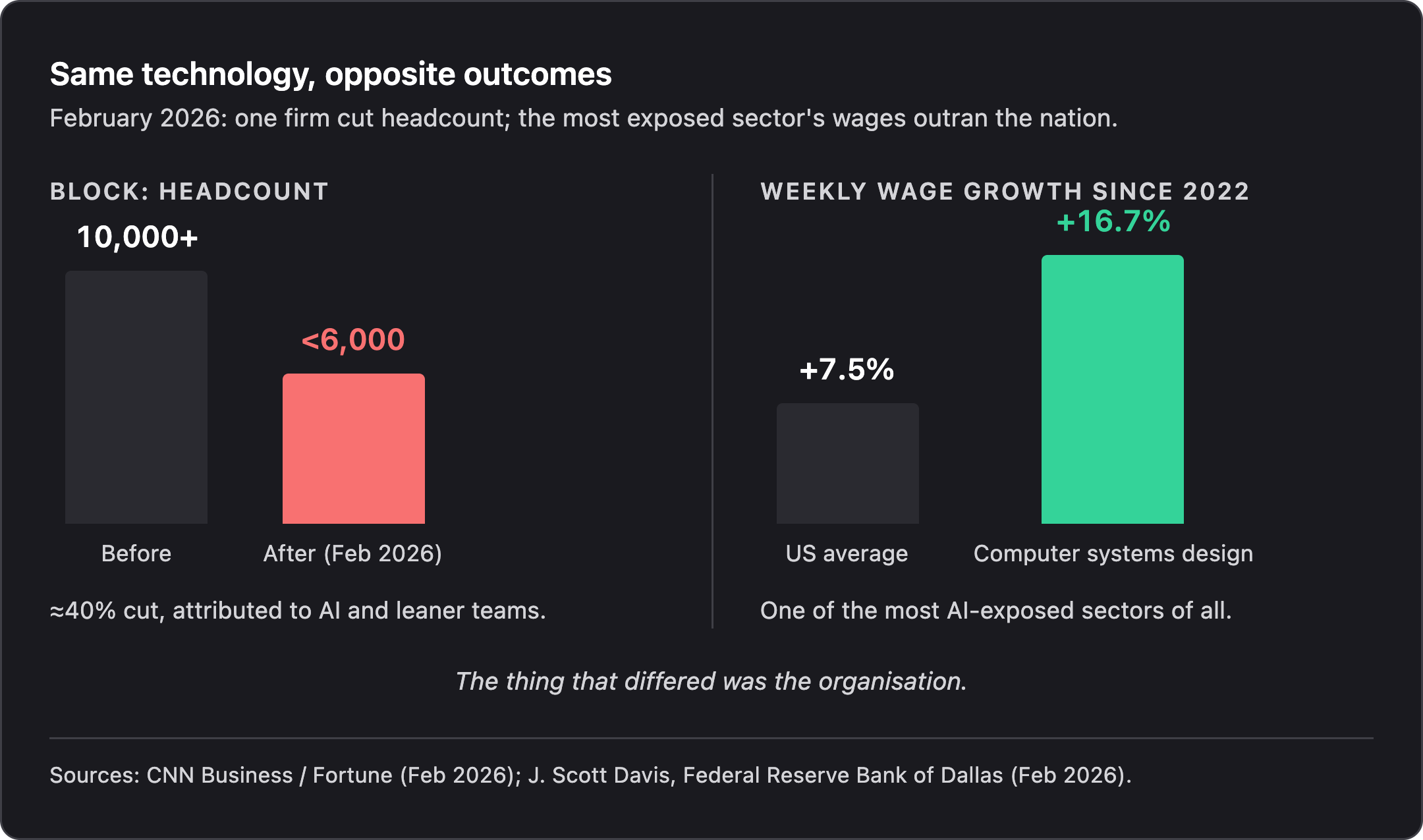
In February 2026, Block cut nearly half its staff. It went from over ten thousand people to just under six thousand, and Jack Dorsey put the reason in writing: the AI tools the company was building and using, combined with leaner teams, had changed what it takes to build and run a company. He wrote that he would rather get there on his own terms than be forced into it reactively, and he predicted most firms would follow within a year.
In the same months, the Federal Reserve Bank of Dallas was looking at the same technology and finding something close to the opposite. In the industries most exposed to AI, wages were rising faster than the national average. Computer systems design, one of the most exposed sectors of all, had seen weekly wages climb at more than twice the national rate.
Same technology. Opposite outcomes. The thing that differed was the organisation.
That is the argument of this last post. The first post said the agent was never the strategy: when attempts get cheap, judgment gets scarce. The second said the codebase is the terrain you prepare. Neither is the whole story. What finally decides what all those cheap attempts are worth, and who that worth goes to, is the organisation that has to absorb them.
Since I started drafting this series, software has reached harder for the same word. Warp is writing about cloud software factories, Addy Osmani describes factories as agent loops at scale, and AI Engineer World's Fair gave software factories a track of their own. I think they are pointing at the right unit of change. This post is about what the word carries with it. If "factory" only means more automation, we miss the hard part of the analogy.
The factory was the real invention
When we tell the story of the Industrial Revolution, we put the machine at the centre: the spinning jenny, the water frame, the steam engine. But the machines on their own were close to useless. What made them matter was the factory, a new way of organising work that gathered people and power under one roof, set the pace by the machine rather than the worker, and turned scattered crafts into a system. Historians still argue about why the factory won. Joel Mokyr reads it as a matter of knowledge, Stephen Marglin as a matter of control. On either reading, the deep change was organisational as much as mechanical, and the factory was the invention that made the machine pay.
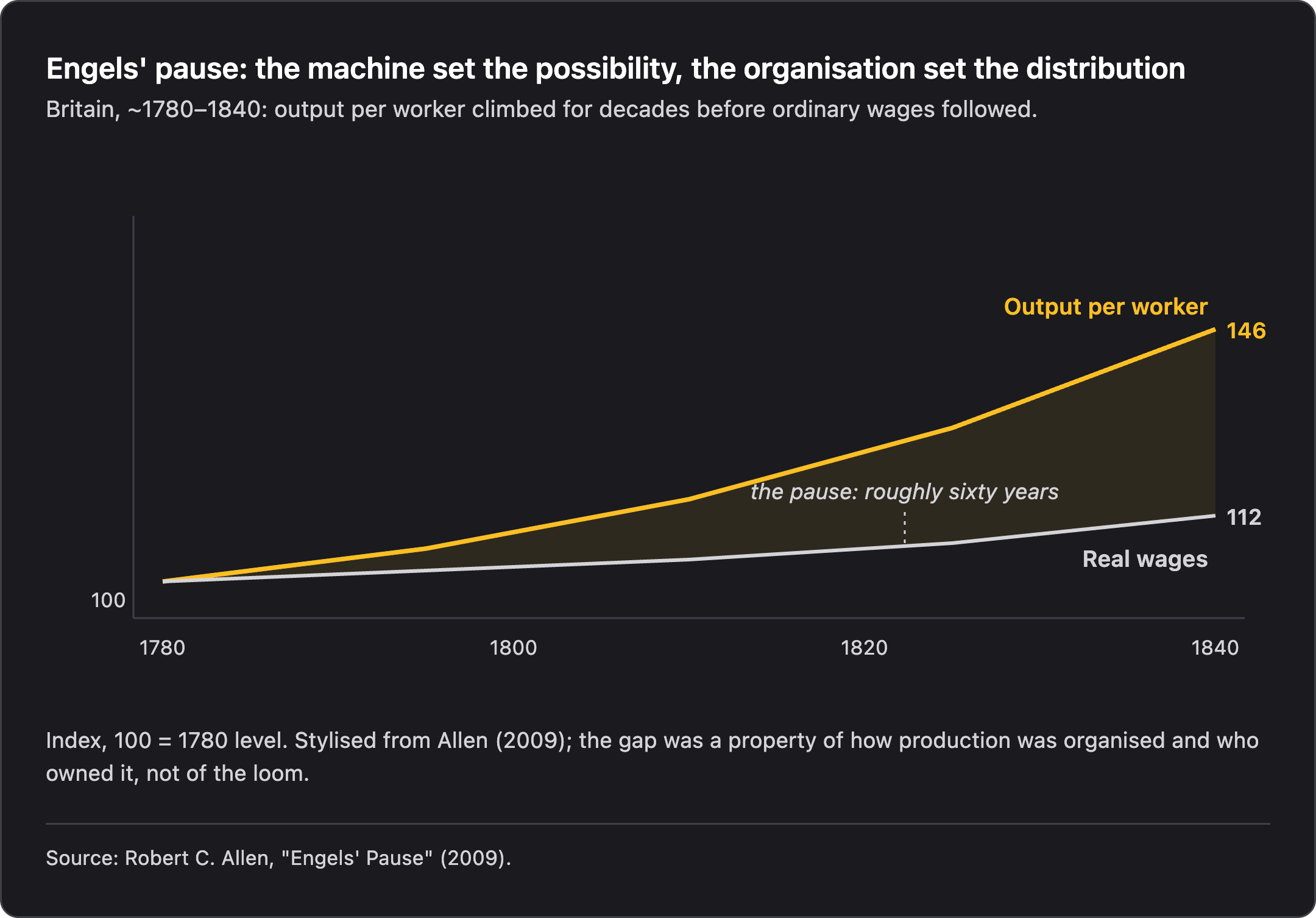
It also decided who got the gains. I wrote in the first post about Engels' pause, the roughly sixty years when British output per worker climbed and ordinary wages barely moved. That gap was not a property of the loom. It was a property of how production was organised and who owned it. The machine set the possibility. The organisation set the distribution.
That is the pattern worth borrowing, because the Industrial Revolution version of the word is heavier than "more automation." The factory is not just where the machine runs. It is the organisational form that decides what the machine's output does to work.
When the work outruns the approvals
Put the first two posts together: when attempts are cheap and the terrain is prepared, output per person goes up. In my own rebuild, a strict split between the human who owned the decisions and the agent that owned the execution shipped the first stream, eighteen stories across ten pull requests, in two evenings. That is not a story about a clever model. It is a story about how much one person can now push through.
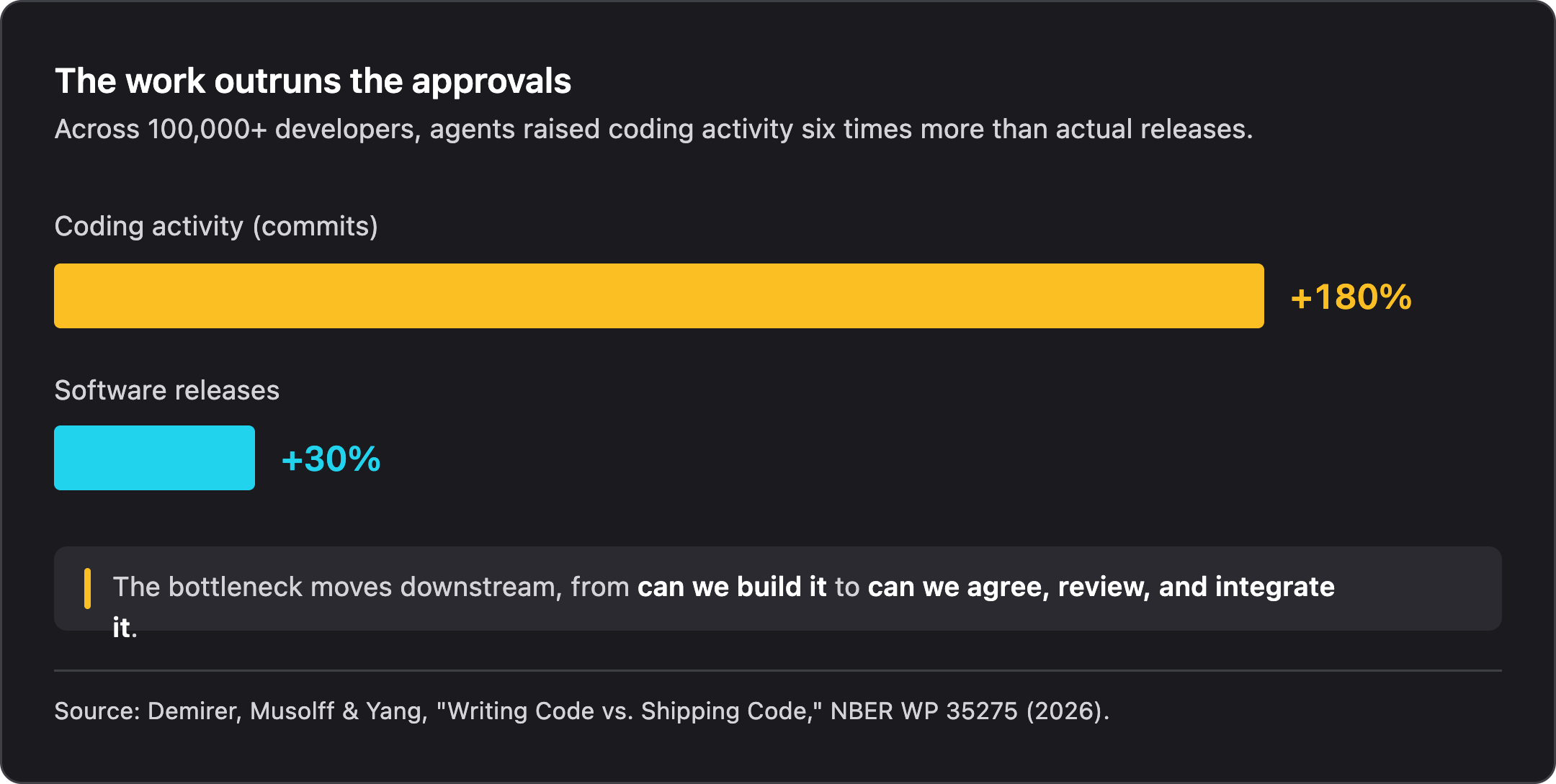
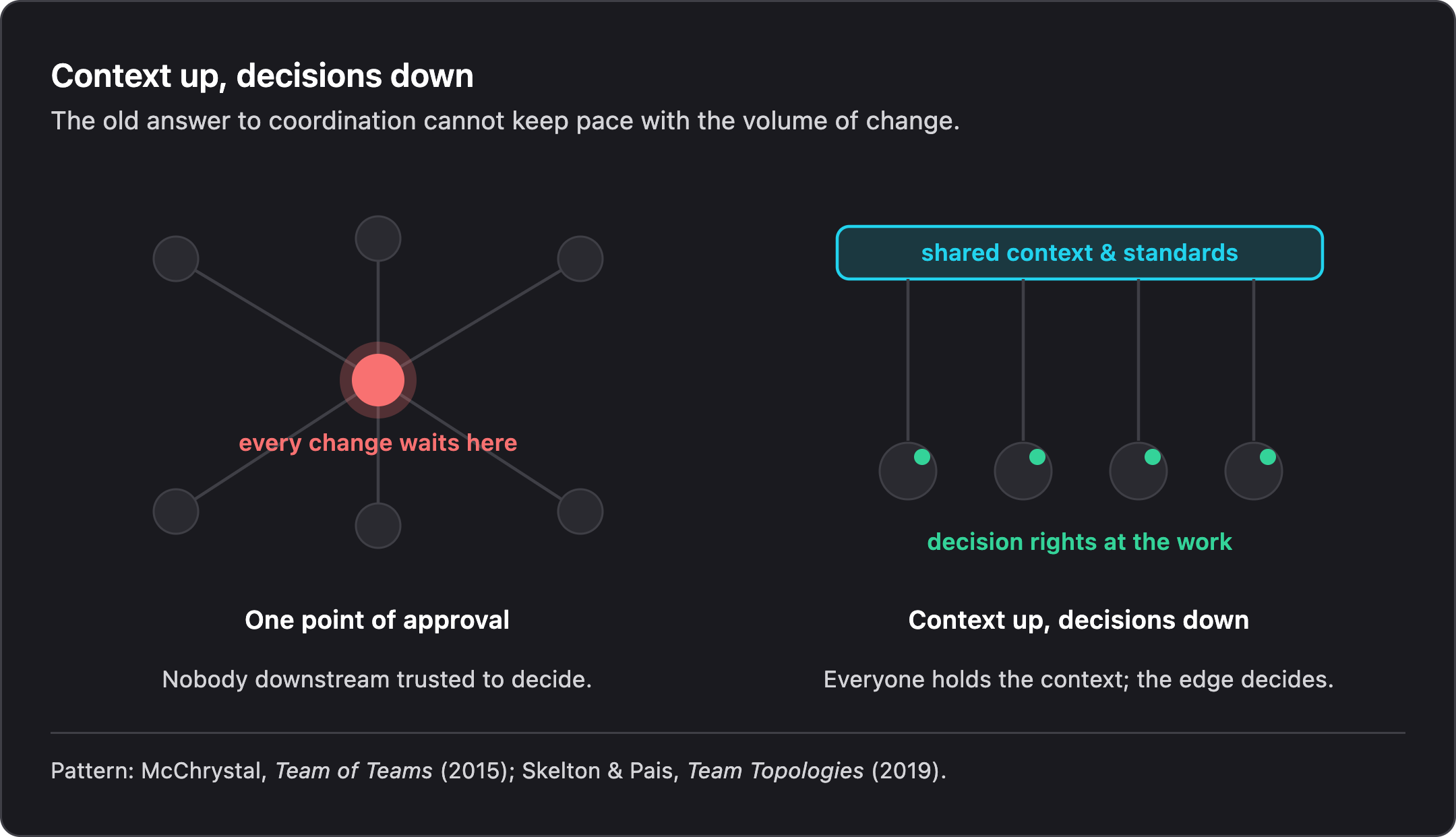
And that is exactly where the problem moves. When each person can produce far more, the scarce resource is no longer the producing. It is the coordinating and the checking. The gap is already measurable: a study of more than a hundred thousand developers found that autonomous coding agents raised coding activity, measured as commits, by about a hundred and eighty percent, but actual software releases by only about thirty. The bottleneck shifts from "can we build it" to "can we agree on what to build, review what got built, and stop several people's work from colliding." The old answer to coordination, where one person signs off on everything and nobody downstream is trusted to decide, becomes the new version of the factory-floor constraint. It cannot keep pace with the volume of change coming at it.
The people building these systems have seen the same shift from below, and they describe it well. Osmani's framing is that the agent can ship more than you can review, so the engineer's job moves to owning the outer loop: the constraints, the sampling, the final verdicts. Warp's factory keeps humans at the gates where ambiguity and risk live. Putting humans at the boundary is the right mechanic. The questions that decide the outcome sit one level up: who assigns those gates, who is trusted to hold them, whose budget staffs them, and what the organisation does with the throughput once it exists.
This is where two books I have read are useful, borrowed as patterns rather than gospel. Stanley McChrystal's Team of Teams argues for shared consciousness across a system paired with decentralised execution: everyone holds the context, and the people closest to the work are trusted to act on it. Matthew Skelton and Manuel Pais, in Team Topologies, make the structural version of the same case: clear team boundaries and deliberately managed cognitive load, so teams are not drowning in everything at once. The shape both point to is the same. Push decision rights down to where the work is and pull context and standards up so the decisions are good. That is the organisational answer to absorbing cheap attempts, and it is the opposite of routing every change through a single point of approval.
Who captures the gains is a choice
Now the hard part, and I want to give it to you with the evidence pointing in more than one direction, because it does.
Start with the reassuring side: the best current measurement says there is no broad job displacement yet. Hartley, Jolevski, Melo and Moore, in a January 2026 working paper, surveyed US workers and found that about thirty-six percent were using generative AI at work at the end of 2025, up from thirty percent a year earlier, with only small effects on wages in the more exposed occupations and no significant effect on job openings or total jobs. Administrative-data studies point the same way: the early adjustment has come through reallocating tasks and raising productivity, not through layoffs. At the aggregate, the floor has not fallen in. The layoff announcements tell a louder story, and by mid-2026 AI had become the most-cited reason companies gave for cutting jobs, but announcements are claims rather than counts, and the measured aggregates have barely moved.
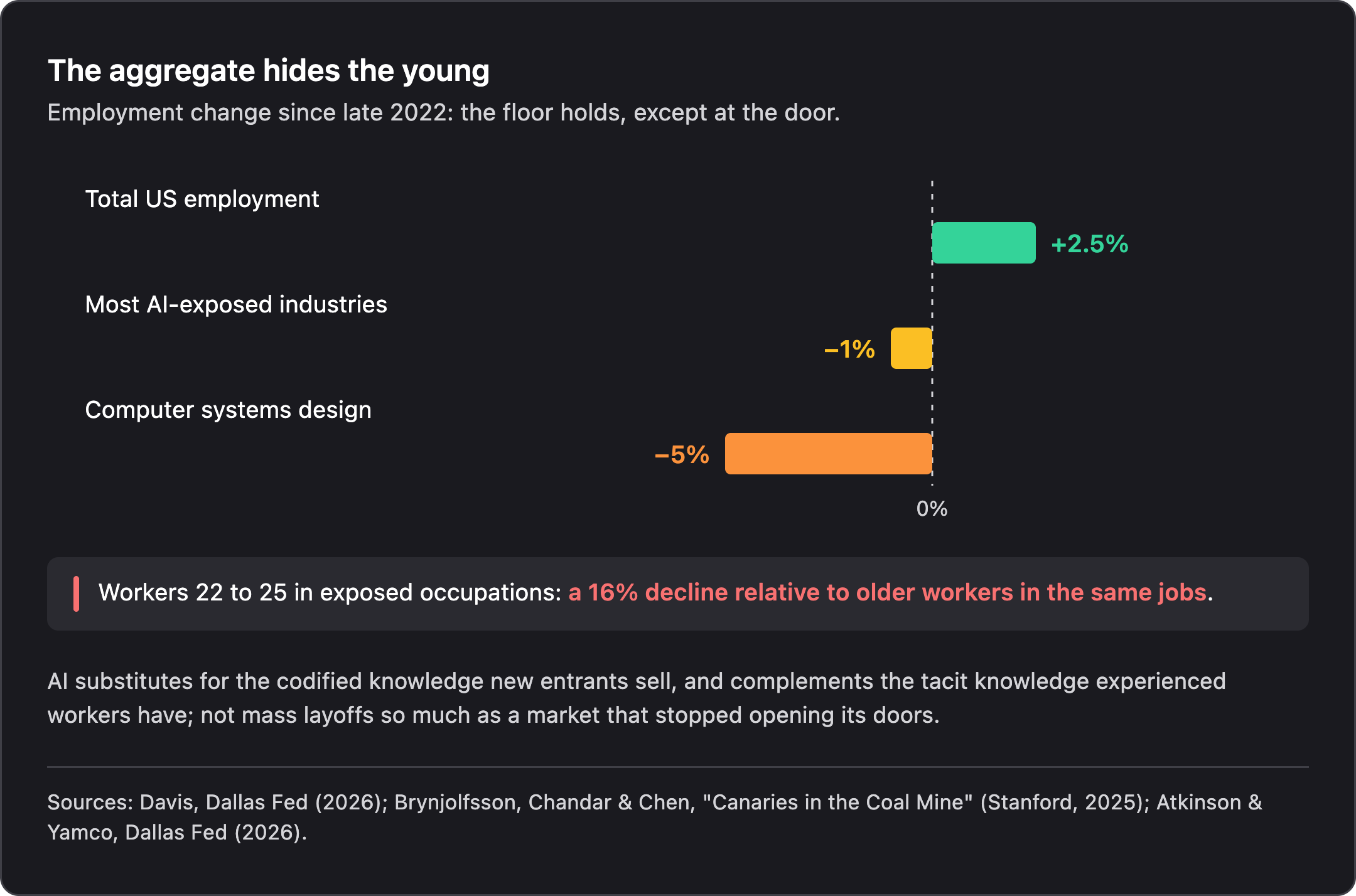
But underneath the aggregate, the picture is uneven, and honestly so. A Stanford study with the apt title "Canaries in the Coal Mine" found that workers aged twenty-two to twenty-five in the most AI-exposed occupations saw their employment fall by about sixteen percent relative to older workers in the same jobs, who held steady or grew. The Dallas Fed's J. Scott Davis found the same shape from a different angle: total US employment up around two and a half percent since late 2022, but employment in the most AI-exposed industries down about one percent, and in computer systems design down about five. His reading is that AI is doing two things at once. It substitutes for the codified, textbook knowledge that entry-level workers sell, and it complements the tacit knowledge that experienced workers have. That is why, in the same exposed sectors, wages can rise while entry-level hiring falls. His colleague Tyler Atkinson adds an important qualifier: the fall for under-twenty-fives looks less like mass layoffs and more like a job market that has stopped opening its doors to new graduates.
Hold the wage story carefully, because it cuts against the simple "AI raises pay" line too. Davis found that across two hundred and five occupations, the relationship between how exposed a job is and how fast its pay grew is close to flat. The sectors gaining are gaining, and the people with genuinely scarce AI skills can command a premium, which PwC's 2025 jobs barometer put at over fifty percent and rising. But there is no broad raise handed out just for working in an exposed field. The productivity has to be passed on for wages to move, and passing it on is a choice.
That is the whole point. Block made the other choice in plain sight, and it is worth being fair about what happened there. Dorsey blamed AI, but he also admitted the company had built two overlapping structures for Square and Cash App and duplicated roles across them. So the cut was partly AI and partly an organisation undoing its own bloat. Either way, the gains showed up as headcount removed rather than work expanded, and the share price rose on the news.
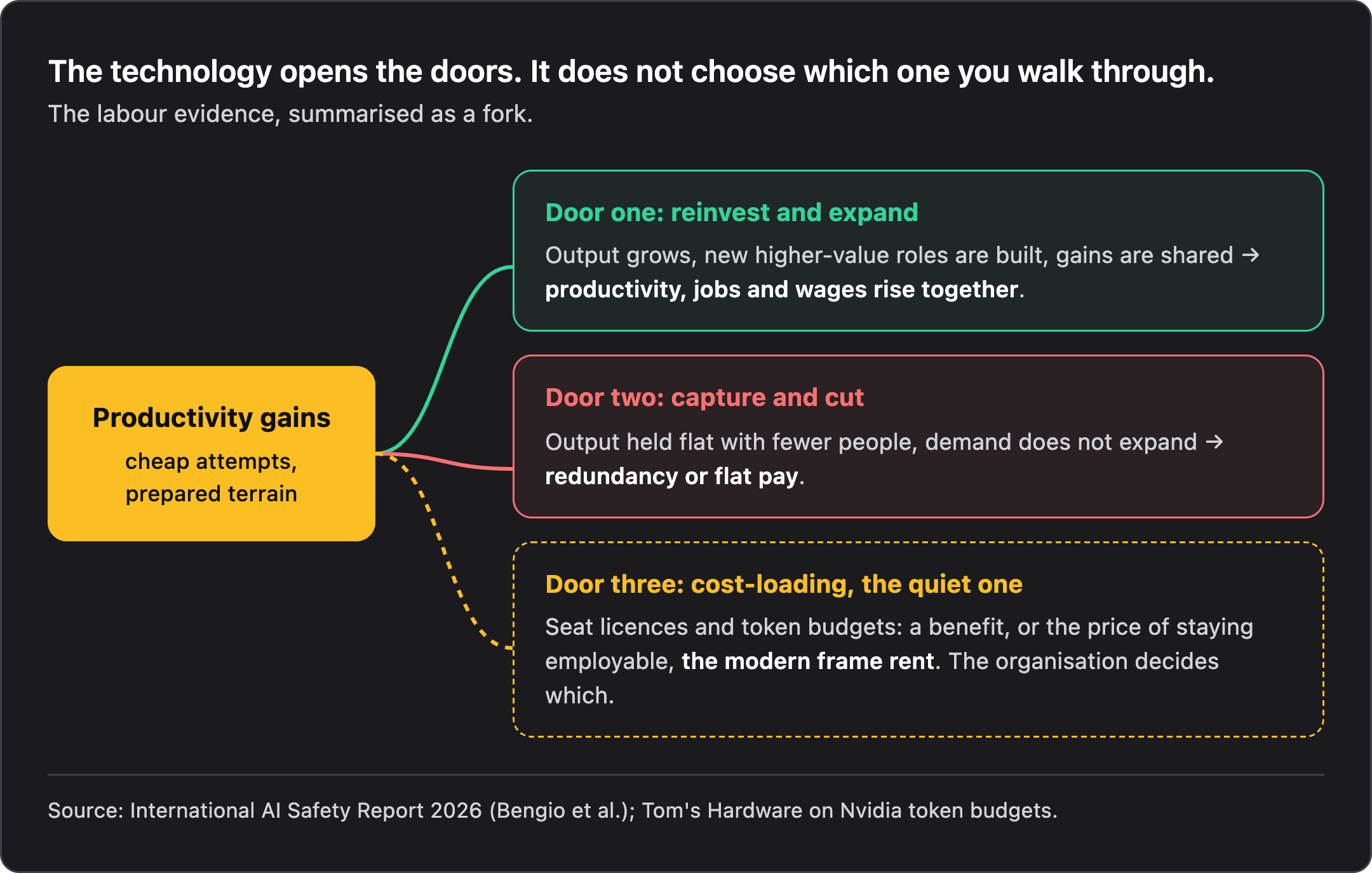
The cleanest statement of the choice comes from the International AI Safety Report published in February 2026, written by over a hundred experts and backed by more than thirty countries and international organisations, which is about as close to a neutral referee as this field has. Its summary of the labour evidence is essentially a fork. When productivity gains let workers produce more and demand for that output grows, employment and wages can rise together. When the same gains let firms hold output flat with fewer people and demand does not expand, they can cut employment or hold down pay instead. The technology opens both doors. It does not choose which one you walk through.
There is a third door, quieter than redundancy or flat wages, that I flagged in the first post: cost-loading. The framework knitters of the 1810s rented the very machines that were undercutting them, and were sometimes paid in goods rather than cash. The instrument of their displacement was also a bill they paid. The modern echo is the seat licence and the token budget. Jensen Huang has floated giving engineers a token allowance worth around half their salary, framed as a benefit. At a firm that is not Nvidia, the open question is whether that allowance stays a benefit or quietly becomes the price of staying employable. Same arrangement, two possible meanings, and the organisation decides which.
So what actually determines the outcome? The evidence here is correlational, but it points one way. Christos Makridis, working with the Gallup Workforce Panel of more than thirty thousand US employees from 2023 into early 2026, found that AI adoption was far higher where workers believed their organisation had a clear AI strategy and where they trusted leadership. Employees who saw a clear strategy were about twenty-seven percentage points more likely to use AI frequently, and where that clarity existed, heavy use came with higher engagement, and in the simpler comparisons with lower burnout too, though the burnout finding is the more tentative of the two. Gallup's own 2026 report, drawing on the same research programme, finds that inside organisations investing in AI, the strongest predictor of whether employees actually adopt it, apart from the technical integration itself, is whether their direct manager actively champions it. Some of this is surely selection, because well-run firms do both things at once. But the pattern is consistent, and it is the organisational variables, not the tools bought, that carry it.
Put it together and the keystone of this whole series falls into place. The deciding variable is not the model and not even the codebase: it is the organisation. The firm that reinvests the productivity, builds new higher-value roles, and shares the gains tends to get all three: productivity, jobs, and wages. The firm that captures the productivity as redundancy, flat pay, or cost passed down to its own staff gets displacement. This is exactly how Engels' pause eventually closed. Not automatically, but because capital was reinvested, institutions adapted, and new kinds of work emerged. The same levers are in front of us now.
What this doesn't fix
The org-design answer is the hard one, and I do not want to make it sound like a tidy solution, because it is neither tidy nor guaranteed.
For a start, it is politically awkward in a specific way. You need shared context across the organisation, but you cannot let the body that provides it harden into the new single point of approval. Team of Teams can turn on itself: the coordinating function that was meant to free people up becomes the next bottleneck the moment it starts deciding everything. The higher-value roles that are supposed to absorb displaced work do not appear on their own either. Someone has to design them on purpose, and most organisations under delivery pressure will not stop to do that.
There is also a blunter problem, which is that the productivity this entire argument rests on is, in aggregate, still mostly unproven. Gallup's 2026 report notes that only around one in eight employees in organisations that have brought AI in strongly believes it has changed how their work gets done. It cites a contested MIT figure, that despite thirty to forty billion dollars of enterprise investment, about ninety-five percent of organisations have seen no measurable impact on profit, and an NBER survey in which the large majority of executives reported no effect on labour productivity. So the honest position is uncomfortable: the gains are real where the conditions are right, and largely absent where they are not, and the conditions are organisational. That is consistent with everything above, but it should keep anyone from triumphalism.
And not every firm will choose well. Block is the proof that the redundancy door is real and that markets reward walking through it. There is no law that bends this toward a good outcome. The reason the first Industrial Revolution eventually shared its gains was that institutions were built to make it do so, against resistance, over decades. The equivalent today is a deliberate function inside an organisation whose job is to steward how the gains and the costs of this technology get distributed: who is retrained rather than removed, whose budget the tools come out of, which work is expanded rather than cut. That function is not automatic, and right now in most places it is being performed by default, which is to say not at all.
What this leaves you with
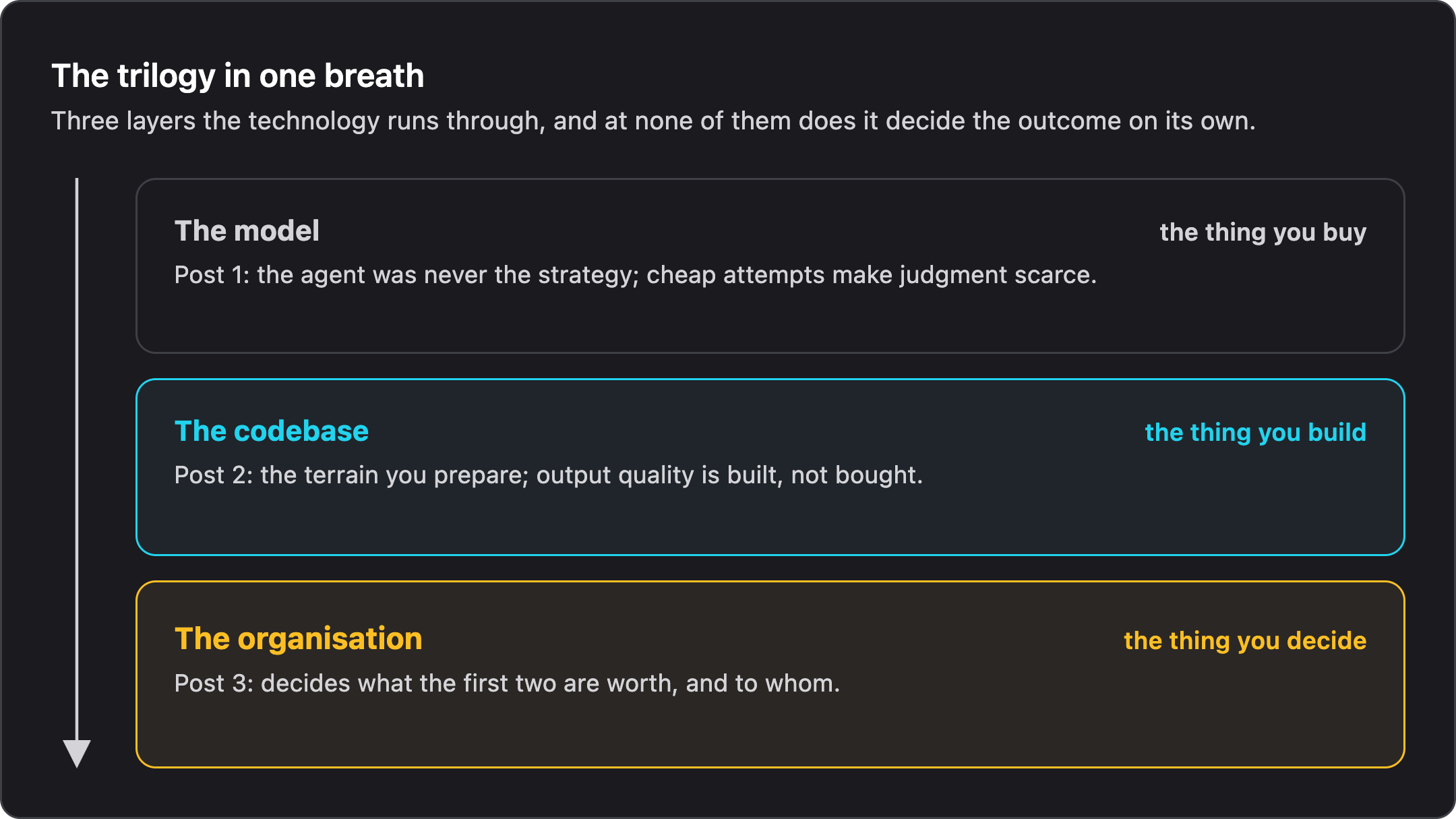
So here is the trilogy in one breath. The agent is not the strategy; cheap attempts make judgment the scarce thing. The codebase is the terrain; output quality is something you prepare, not something you buy. And the organisation is what decides what the first two are worth, and to whom. Each one is a layer the technology runs through, and at none of them does the technology decide the outcome on its own.
That is the thread running through all three posts, and it is deliberately an anti-prediction. We have had two centuries and full archives to study the last great transition and we still cannot agree on what caused it or how deep its costs ran. Anyone who tells you with confidence what this one will do to your engineers, your wages, or your org chart is overreaching. The smaller and more useful claim is that the outcome is not sitting inside the tools waiting to be revealed. It is being chosen, right now, mostly without anyone deciding to choose it.
If you lead engineers, that is the part worth sitting with. The model is the thing you buy; the terrain is the thing you build. And the distribution, who the productivity is actually for, is the thing you decide. None of it is a property of the technology. All of it is a property of the organisation you put around it.
Sources
The current software-factory conversation
- Warp, "A guide to cloud software factories for engineering leaders."
- Addy Osmani, "Loop Engineering."
- Addy Osmani, "Own the Outer Loop."
- Zach Lloyd, "Self-Improving Software Factories," AI Engineer World's Fair 2026.
The factory as organisational invention
- Stephen A. Marglin, "What Do Bosses Do? The Origins and Functions of Hierarchy in Capitalist Production," Review of Radical Political Economics 6:2 (1974); DOI: 10.1177/048661347400600206 (paywalled) — the factory as organisational control and the capture of the surplus, rather than technical necessity.
- Joel Mokyr, "The Rise and Fall of the Factory System: Technology, Firms, and Households since the Industrial Revolution" (author's copy), Carnegie-Rochester Conference Series on Public Policy 55 (2001); RePEc record — the knowledge-based reading of why the factory won.
- Sidney Pollard, The Genesis of Modern Management (Harvard University Press, 1965; borrowable at the Internet Archive), and "Factory Discipline in the Industrial Revolution," Economic History Review 16:2 (1963, paywalled) — factory discipline and management as the organisational innovation.
- Robert C. Allen, "Engels' Pause" (2009, author's copy) — the ~60-year gap between output and wages as a question of organisation and ownership. Full citation in Post 1.
The coordination pattern
- Stanley McChrystal et al., Team of Teams (Portfolio, 2015) — shared consciousness across a system plus decentralised execution.
- Matthew Skelton & Manuel Pais, Team Topologies (IT Revolution, 2019) — clear team boundaries and deliberately managed cognitive load.
- Demirer, Musolff & Yang, "Writing Code vs. Shipping Code" (NBER Working Paper 35275, May 2026) — across 100,000+ developers, successive generations of AI coding tools raised coding activity (commits) by up to ~180%, but actual releases by only ~30%; the bottleneck moves downstream to review, integration and release.
No aggregate displacement yet
- Jonathan S. Hartley, Filip Jolevski, Vitor Melo & Brendan Moore, "The Labor Market Effects of Generative Artificial Intelligence" (Working Paper, Jan 2026) — ~35.9% of US workers were using generative AI at work as of Dec 2025, up from 30.1% in Dec 2024; small effects on wages in more exposed occupations; no significant effects on job openings or total jobs.
- International Center for Law & Economics, "AI, Productivity, and Labor Markets: A Review of the Empirical Evidence" (Feb 2026) — survey of the current evidence; early adjustment through task reallocation, not layoffs.
- Challenger, Gray & Christmas job-cut data, via CNBC (5 Jun 2026) and TechCrunch's running list of AI-cited 2026 layoffs (updated 6 Jul 2026) — AI as the most-cited stated reason for US job cuts by mid-2026; the announcements-versus-aggregates gap.
The uneven, early-career effect
- Erik Brynjolfsson, Bharat Chandar & Ruyu Chen, "Canaries in the Coal Mine? Six Facts about the Recent Employment Effects of Artificial Intelligence" (Stanford Digital Economy Lab, 2025) — ~16% relative employment decline for workers aged 22–25 in the most AI-exposed occupations; experienced workers stable or growing; adjustment via employment, not pay.
- J. Scott Davis, "AI is simultaneously aiding and replacing workers, wage data suggest," Federal Reserve Bank of Dallas (24 Feb 2026) — total US employment +2.5% since fall 2022, AI-exposed industries ~-1% (computer systems design ~-5%), while computer-systems-design wages rose 16.7% vs 7.5% nationally; flat exposure/wage relationship across 205 occupations; codified vs tacit knowledge framing.
- Tyler Atkinson & Shane Yamco, "Young workers' employment drops in occupations with high AI exposure," Federal Reserve Bank of Dallas (6 Jan 2026) — the under-25 employment fall in exposed occupations as a falling job-finding rate for new entrants, not layoffs.
- PwC, Global AI Jobs Barometer (2025) — wage premium of over 50% for workers with AI skills, more than double the prior year. (Secondary figure; PwC's own.)
The fork and the capture modes
- International AI Safety Report 2026 (Yoshua Bengio et al., Feb 2026) — productivity gains can raise employment and wages when demand grows, or reduce them when firms hold output flat with fewer workers and demand does not expand.
- Block layoffs: CNN Business (26 Feb 2026); Fortune (27 Feb 2026) — ~40% cut, from over 10,000 to just under 6,000, Dorsey citing AI and predicting others follow, while also acknowledging duplicated Square/Cash App structures.
- Jensen Huang's token budgets (Tom's Hardware) — the "frame rent" parallel and remaining citations carry over from Post 1.
The organisation is the variable
- Christos Makridis, "The Organizational Transmission of AI: The Role of Managers on AI Adoption and Impact" (SSRN, 2025/2026) — Gallup Workforce Panel, 30,000+ US employees 2023–Q1 2026; a clear AI strategy is associated with ~27 percentage points higher frequent use; clarity concentrated where there is trust in leadership; the burnout relief appears in the pooled comparisons but attenuates in the paper's main within-person estimates. Working paper; associations, not causal identification. Accessible write-up: The Conversation / SingularityHub (Apr 2026).
- Gallup, State of the Global Workplace 2026 (full report; the figures cited are in the CEO foreword) — manager championing as the strongest predictor of employee AI adoption aside from technical integration; ~12% of employees in AI-implemented organisations strongly agree AI has transformed how work gets done; cites the MIT NANDA study (95% of organisations with no measurable profit impact despite $30–40bn invested; contested and not peer-reviewed) and the NBER executive survey (Yotzov et al., "Firm Data on AI," NBER WP 34836: 89% report no labour-productivity effect to date).
The build
- Rebuilt fine-tuning pipeline: coffee-first-crack-detection
- Consolidated MCP server (two servers into one, driver-level validation passed): coffee-roaster-mcp
- The deterministic agent harness (built and running; not yet hardware-validated end to end): roastpilot-agent
- The cloud data plane for roast sharing and tasting feedback (early, in progress): roastpilot-cloud
- The prototype being replaced: bean-agent